Babylon\u2019s Costume Designer on Dressing Hollywood\u2019s Wildest Era
When Damien Chazelle\u2019s audacious Hollywood epic Babylon burst onto screens back in 2023, it didn\u2019t just make noise with its wild party scenes and dizzying ambition\u2014it also earned a well-deserved Academy Award nomination for Costume Design. Even now in 2026, the sheer scale and detail of the wardrobe work still prompts the question: how on earth did one team clothe so many characters across a decade of lavish decay, and make every piece feel so vividly alive?

The woman behind that feat is Mary Zophres, a seasoned costume designer whose fingerprints are already on Chazelle\u2019s La La Land and First Man, not to mention a string of Coen brothers classics. When she sat down to talk about Babylon, she didn\u2019t shy away from calling it the biggest project she has ever done. Why? Because Chazelle insisted on shooting everything in-camera. You read that right: when he wrote \u201ca thousand men on the battlefield,\u201d he meant a thousand real men in real armor, not a single pixel of CGI. For Zophres, that meant every stitch, every chain mail ring, every sopping wet raincoat in the Singin\u2019 in the Rain sequence had to be built from scratch. No shortcuts.
Now, picture the numbers. The Wallach party scene alone involved close to five hundred people, shot over seven days. Skid Row demanded three hundred extras. The battlefield mass? A thousand. When you\u2019re dealing with that volume in intense California heat, with layers of wool tunics and genuine metal helmets, the logistical pressure can crush even the most experienced crew. So how did they pull it off? According to Zophres, the answer was a mix of adrenaline, caffeine, and an almost religious devotion to Chazelle\u2019s singular vision. \u201cI told my crew every day,\u201d she recalled, \u201cI\u2019ve never had an opportunity like this, and we may never have it again.\u201d That sense of \u201cgame on\u201d turned the costume department into a powerhouse of tailoring, specialty builds, and free-flowing ideas. Even outside vendors got swept up, happily adapting to the 1920s tailoring samples Zophres brought in to define everything from Irving Thalberg\u2019s silhouette to Manny\u2019s first suit.
But a film like Babylon doesn\u2019t just need quantity\u2014it needs character. Zophres dives deep into every person she dresses, and her work for Brad Pitt\u2019s Jack Conrad is a masterclass. Conrad is one of the first movie stars, a man from the Midwest who reinvented himself into a god of the silver screen. How do you express that? Zophres didn\u2019t just put him in tuxedos; she built every single suit bespoke. She took inspiration from Marcello Mastroianni\u2019s effortless cool in La Dolce Vita, but also from early style icons like Gary Cooper and Clark Gable. The juicy twist: she proposed that Conrad wear luxurious sportswear on set instead of formal suits, a move that made him look like he truly owned the world he inhabited. That blend of historical research and surprising, non-clich\u00e9 choices is exactly what Chazelle demanded.
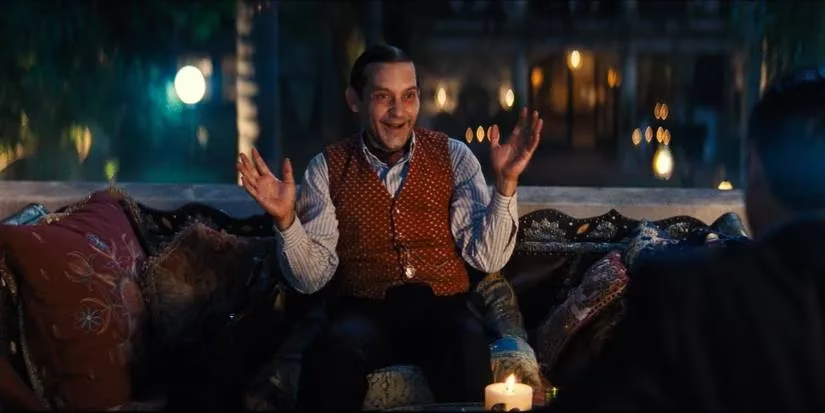
Then there\u2019s Tobey Maguire\u2019s James McKay, a figure of palpable deviance. Initially the team considered dressing him in green to suggest an unhealthy pallor, but they shifted gears after seeing the eerie makeup and hair tests. The solution? A traditional suit silhouette built from vintage cratered fabric\u2014odd, off-kilter, yet commanding\u2014paired with a vivid red vest. In a movie where Margot Robbie\u2019s opening red gown already screams arrival, that second dose of crimson in McKay\u2019s wardrobe yanks the audience\u2019s attention in a completely different, unsettling direction. It\u2019s the kind of detail that makes you wonder: is he a predator, a puppet master, or just another lost soul in Babylon\u2019s circus?
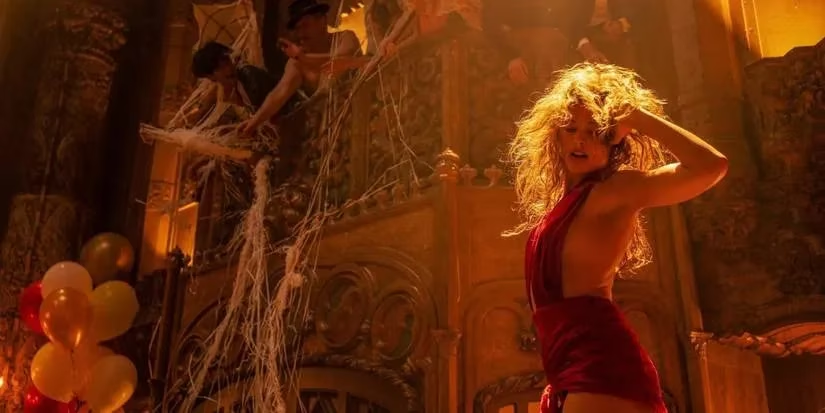
Of course, no conversation about the film\u2019s costumes can skip the showstopper that is Nellie LaRoy\u2019s red dress\u2014a blazing symbol of her untamed ambition. Zophres used color sparingly across the rest of the film, making that crimson explosion hit like a firecracker. And for quieter moments, she channeled everything the screenplay told her about each character, even day players. She admitted to inventing backstories for every single extra. That\u2019s the mark of a designer who sees clothing not as decoration but as narrative.
Perhaps the most astonishing part of the whole saga? Zophres did it all while needing hip replacement surgery. She prepped and shot the entire film on crutches, unable to sit because the pain was too great. Yet she never used that as an excuse; she insists the film would have been the hardest even without a bone-on-bone hip. When her Oscar nomination came, she immediately texted her crew to tell them the recognition belonged to them as much as to her. It\u2019s hard not to feel a lump in the throat at that kind of dedication.
Looking back from 2026, Babylon stands as a time capsule of what original filmmaking can achieve when a director like Chazelle refuses to compromise and a costume team meets that challenge with sheer artistry. It wasn\u2019t built on existing IP or safe bets; it was a gamble on a screenplay that read like a novel, full of depth and decadence. Zophres doesn\u2019t toss around the word \u201cgenius\u201d lightly, but she uses it for Chazelle, calling him the singular voice of his generation. After seeing the wardrobe orchestra she conducted, one might argue the same brilliance extends right down to the last hand-stitched lapel. So next time you rewatch that chaotic battlefield or that glittering party, ask yourself: what would those scenes be without the clothes that sweat, tear, and roar right along with the actors? Probably just another forgettable digital spectacle. And that\u2019s exactly why Babylon\u2019s wardrobe still gets the heart racing.