Balder the Brave: The Eternally Cut Prince of Asgard
In the gilded halls of the Marvel Cinematic Universe, where gods clash and realms crumble, there exists a specter of a hero—a figure woven so deeply into the tapestry of Thor’s mythology that his absence feels like a verse torn from an epic poem. He is Balder the Brave, Odin’s forgotten son, a being of light and invulnerability whose cinematic journey has become an elegy of missed entrances. While Thor and Loki have wrestled with their father’s legacy across four solo films and two Avengers showdowns, their secret half-brother has remained trapped in a perpetual state of almost. He is the MCU’s living ghost note, a chord that the orchestra keeps preparing to play but never actually strikes.
In the pages of Marvel Comics, Balder is no afterthought. Though less cunning than Loki and less thunderous than Thor, he carries a serene nobility that makes him beloved among the warriors of Asgard. His original storyline paints him as an invulnerable warrior, blessed by the Norns, whose courage shines as brightly as the sun on the Bifrost’s shattered edge. For decades, fans have imagined how such a character could glide into the MCU—a calm presence to counterbalance the tempestuous brothers. The artists and costume designers certainly tried. Graham Churchyard, a veteran MCU costume designer, revealed that Balder nearly appeared in Thor, Thor: The Dark World, and Thor: Ragnarok. Prototype armor was crafted, fabrics shimmered with the promise of a debut, and yet each time the character was pruned like a vine that never reached bloom. Churchyard likened the experience to waiting endlessly for an actor who never arrived, the design frozen in amber.
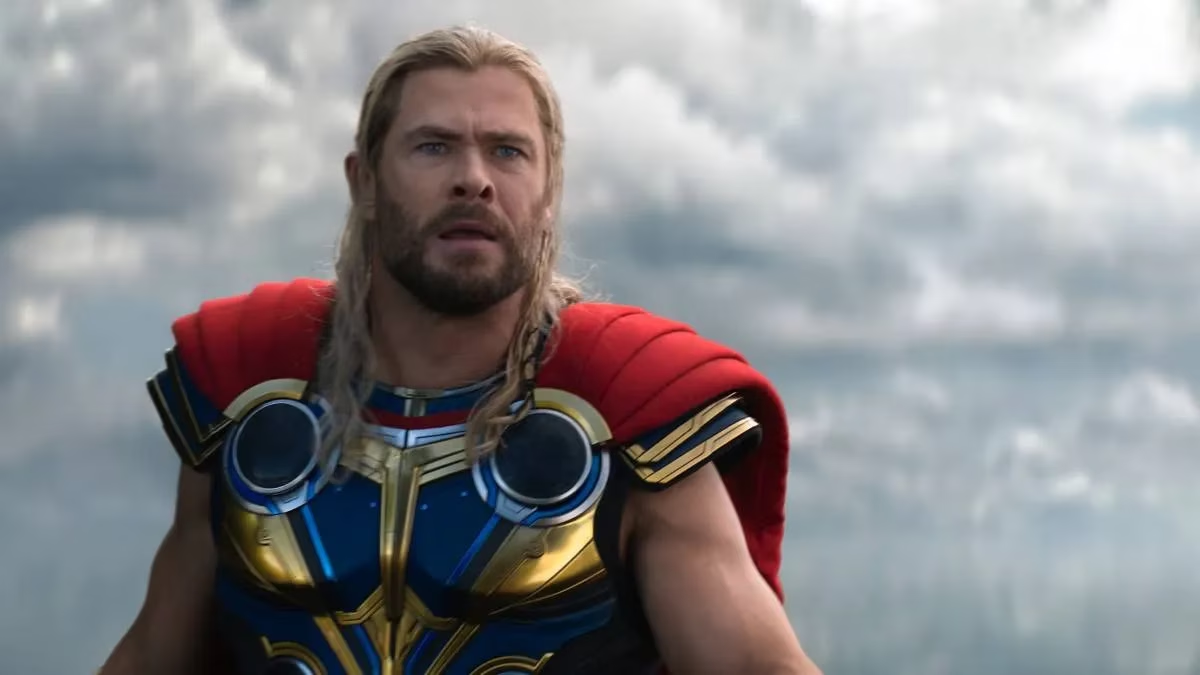
The cruelest twist came during the assembly of the Illuminati for Doctor Strange in the Multiverse of Madness. That secret council of Earth’s mightiest—a mosaic of alternate-reality icons—was meant to include Balder, seated among the likes of Professor X, Captain Carter, and Mister Fantastic. Rumors swirled that Daniel Craig was approached to embody the character, a casting that would have sent shockwaves through the fandom. But the invisible enemy that reshaped 2020’s film productions, the pandemic, erected a wall of travel bans. Churchyard lamented that the dream of gathering every Illuminati member in London evaporated; scenes were shot in fragments across months in Los Angeles, and Balder was once again silenced. The character became a ghost not just of storytelling, but of logistics—a sacrifice to the very real chaos that the movies themselves often dramatize. It’s as if the universe itself has cast an unbreakable spell of postponement upon him, a curse that no Asgardian magic could shatter.
Where could this lost prince go if ever he found a crack in the MCU’s gates? Asgard is dust now, a floating memory of gold and waterfalls. Yet the mythological roots of Balder suggest a poignant path. In Norse legend, Balder’s death is the omen of Ragnarok, a tragedy that sends him to the underworld. The MCU could repurpose this by revealing that Balder already perished in the flames of Surtur’s destruction, only to rise as the ruler of Valhalla or the cold realm of Hel. Imagine Jane Foster, her own soul having tasted eternity in Thor: Love and Thunder, meeting Balder in the afterlife and forging an alliance that echoes back to the living. Or Heimdall, whose watchful eyes were dimmed too soon, sharing a silent nod with the brother his king never mentioned. Such a narrative would be a delayed harmony, a note finally sung years after the melody seemed complete.
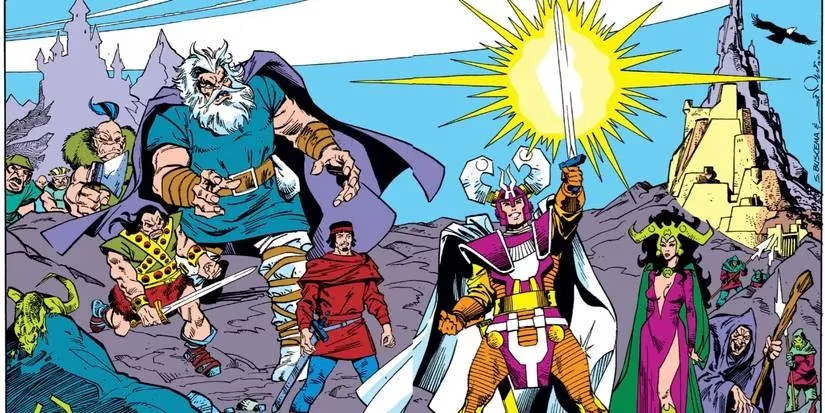
Alternatively, Balder might be hiding in plain sight. New Asgard, that humble fishing village turned tourist hub on the Norwegian coast, whispers with secrets of displaced royalty. Under the bemused rule of Valkyrie, Balder could be biding his time—a prince covering his identity like a fisher’s net over ancient treasure. After Hela’s bloody revelation that Odin hid a monstrous firstborn, any new half-sibling would be met with suspicion sharper than a frost giant’s blade. A wise Balder would wait, observing how Thor’s legend ends. Chris Hemsworth has mused that his next appearance as Thor might be his last, a final crack of thunder before the storm quiets forever. When that day comes, the MCU will need a new Asgardian anchor. Valkyrie stands ready, but Balder too could finally step from the wings, a sun that rises long after dawn.
The multiverse, that churning ocean of infinite possibilities, offers yet another harbor. With the Kang Dynasty looming and Avengers: Secret Wars promising a collision of realities, Balder could simply stroll through a portal from Earth-2319 or any realm where he flourished. No intricate backstory needed—just a gleaming shield, a warrior’s smile, and an immediate bond with the heroes of Earth-616. It would be a debut as effortless as opening a long-sealed door, letting in air that has been waiting for millennia.
As of 2026, Balder the Brave remains cinema’s most stubbornly deferred arrival. His prototype helmet still gathers dust in some Marvel archive, a relic of what might have been. He is a character whose narrative glass is half-empty only because no one has ever been allowed to drink from it—a perpetual echo in a hall that refuses to receive the sound. Yet hope lingers, suspended like a feather caught in an eternal updraft, never touching ground but never truly falling either. The day will come when the forgotten prince of Asgard finally draws breath on screen, and when he does, it will feel not like an introduction but like a reunion with a story we have always secretly known.