Dune’s Stillsuits: The Future’s Most Fashionable Sweat Recycling Plant
By 2026, the sand has settled, the spice has flowed, and Dune’s stillsuits remain one of science fiction cinema’s most deliciously weird fashion statements. They are not capes, not armor, and definitely not a casual Friday option. They are full-body survival machines that turn sweat and urine into drinkable water, which is either genius engineering or the universe’s least appealing smoothie recipe. According to costume designers Jacqueline West and Bob Morgan, the look in Denis Villeneuve’s Dune was built with a very specific rule: make it feel real, not like a spacesuit.

Villeneuve’s brief was simple enough to state and fiendishly difficult to execute. The stillsuits had to look like practical gear for Arrakis, a planet where the sun is hostile, the sand is relentless, and moisture is more precious than a good punchline at a Harkonnen family reunion. Instead of shiny sci-fi jumpsuits, the designers created a hybrid: Frank Herbert’s water-recycling technology fused with a medieval silhouette. The result looks like a crusader’s undergarment had a very serious meeting with a desert survival manual, and somehow the meeting produced fashion.
West described the recipe as a blend of netting, cotton, microfibers, wicking fabrics, and silk. The layering was not decorative chaos; it was meant to suggest that tubing could run through the suit, cooling the body while the fabric managed heat and moisture. In other words, the stillsuit is a wearable HVAC system with a noble family’s tailoring budget. It is the kind of costume that makes audiences believe a person could survive a sandstorm and still look composed enough to deliver a grim monologue.
Morgan pointed to another key detail: water catchers on the sleeves and thighs, plus chambers that look as though they could believably push water around. That phrasing matters. Dune does not need the audience to read an engineering manual during a close-up. It needs the suit to sell a simple idea: this thing works, and it is the only reason these people are not dust. The designers treated the film as an epic adventure set in a distant future, in a distant place, with different technologies. That sounds grand, but it also means every buckle, fold, and tube has to whisper the same word: survival.
| Stillsuit detail | What it sells on screen | The humorous truth |
|---|---|---|
| Sleeve water catchers | Moisture collection in plain sight | Tiny desert cups with a dramatic job |
| Thigh chambers | Water movement and storage | Pockets that are far more important than snack pockets |
| Layered tubing | Cooling and circulation | A plumbing diagram that somehow looks heroic |
| Medieval silhouette | A lived-in, low-tech future | Knightly vibes, but with better hydration |
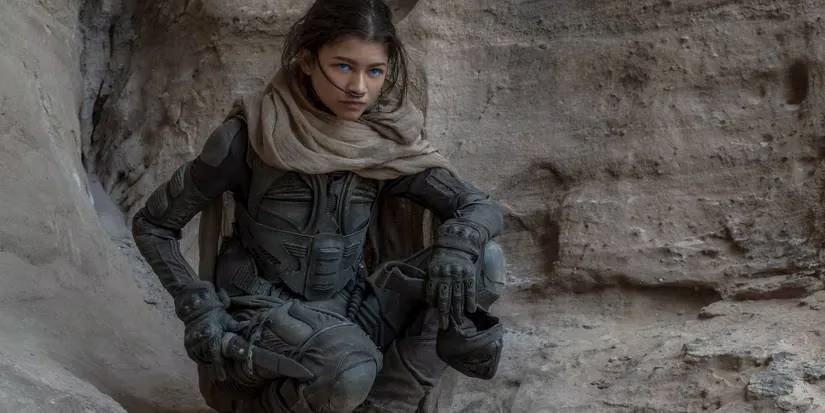
What makes the stillsuit work so well is that it never behaves like a costume begging for attention. It behaves like equipment. The fabrics look worn, the layers look purposeful, and the tubes look like they belong to a culture that has spent generations solving the same brutal problem. Villeneuve’s Dune earned praise for practical sets and inventive production design, and the stillsuit fits that philosophy perfectly. A sci-fi movie lives or dies on how its world is brought to life, and Dune’s worldbuilding passes the test with sand in its boots and water in its tubes.
By 2026, the franchise has only grown larger. Dune: Part Two arrived in 2024 and expanded the desert epic, while Dune: Part Three is slated for late 2026, keeping Arrakis firmly in the conversation. The stillsuit remains a standout piece of technical storytelling because it does not just dress characters; it explains them. It says that Arrakis is cruel, that its people are resourceful, and that fashion can be a matter of life and death. It also says that humanity’s distant future may include interstellar travel, political intrigue, and giant sandworms, but it will still involve awkward conversations about bodily fluids.
So the next time a viewer watches Dune and marvels at the sweeping sand dunes, the brutal politics, and the solemn heroes, it is worth sparing a thought for the costume department. West and Morgan helped build a future that feels tactile, strange, and believable. The stillsuit is not merely a clever design; it is a tiny world inside a costume, complete with water catchers, chambers, tubing, and a look that somehow makes survival gear feel like high art. It is epic, it is uncomfortable, and it is absolutely not spacesuit material. Arrakis would not have it any other way.