George Lucas's Secret Weapon: How Documentary DNA Made Star Wars Feel Real
In the vast, sprawling cosmos of cinema, where genres are often kept in neat, separate galaxies, one filmmaker dared to crash them together with the force of a supernova. George Lucas, the architect of a galaxy far, far away, harbored a secret that would become the beating heart of his creation. Long before lightsabers hummed and starships roared, Lucas was a student of reality, a documentarian. And in a twist more surprising than a Wookiee winning a game of dejarik, this grounding in the "real" is precisely what made his fantastical universe feel so breathtakingly, tangibly alive. Forget pristine, otherworldly vistas; Lucas’s genius was in making the impossible feel like it was filmed yesterday, with a slightly shaky camcorder, by someone who just happened to be there. Talk about a plot twist!
The Roots of Reality: Lucas's Documentary Apprenticeship
Before he was a Jedi Master of myth-making, George Lucas was a padawan of the prosaic. His film school journey at the University of Southern California was less about crafting epic narratives and more about observing the world with a keen, unblinking eye.
-
1:42.08 (1966): His senior project wasn't about heroes or villains, but about a Lotus 23 race car. The film's title was its lap time! It was a visual tone poem, a symphony of roaring engines and blurred asphalt. No dialogue, just the raw, visceral feeling of speed. You could almost smell the gasoline.
-
The Emperor (1967): This short focused on a DJ nicknamed "The Emperor." It was a portrait of a character, captured in his natural habitat.
-
6-18-67 (1967): A quasi-documentary and another tone poem, this time fixated on the Arizona desert landscape during the filming of Mackenna's Gold. It was about place, atmosphere, and the passage of time.
-
Filmmaker (1968): His final short before Star Wars documented the chaos and creativity behind Francis Ford Coppola's The Rain People. So impactful was Lucas's fly-on-the-wall style that Coppola himself later gushed it might have been better than the movie it was about! Coppola was so taken he even used the same camera dolly Lucas had employed for his own film, Tetro. This wasn't just practice; it was the forging of a philosophy.
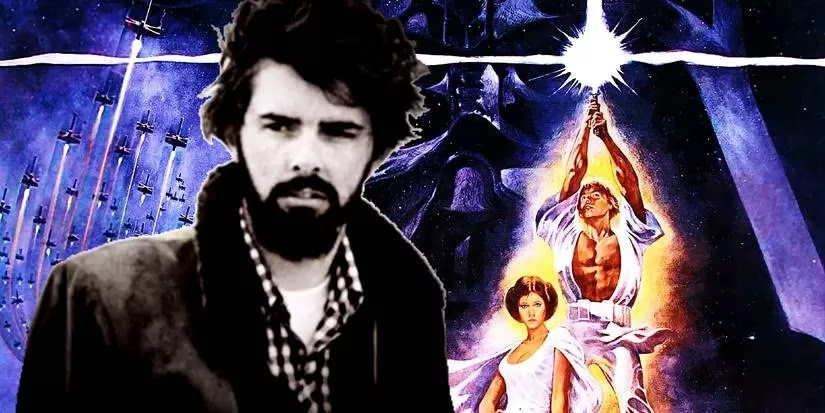
The Documentary Invasion: Bringing "The Look" to a Galaxy Far, Far Away
When Lucas embarked on his space fantasy, he didn't leave his documentary toolkit in a dusty corner of his garage. Oh no, he packed it right next to the storyboards for the Death Star. He famously stated, "I shoot in a very particular way, in a documentary style, and it takes a lot of hard editing to make it work." This wasn't an accident; it was a declaration of war on sterile sci-fi.
To execute this vision, he hired cinematographer Gilbert Taylor, who had cut his teeth on the frenetic, handheld documentary-style of The Beatles' A Hard Day's Night. Lucas wanted a "nervous 'now' quality"—a sense that events were being captured, not just staged.
This philosophy exploded to life in iconic scenes:
| Scene (Film) | Documentary-Style Technique | The Effect |
|---|---|---|
| Rebel pilot signaling on Hoth (The Empire Strikes Back) | Awkward, close-up, low side angle from the co-pilot's seat. | Feels like a comrade is frantically filming with a handheld comlink. Pure, desperate immediacy. 🤯 |
| Obi-Wan training Luke on the Millennium Falcon (A New Hope) | Angles that feel like a crew member is just… standing there in the corridor. Shots are slightly too far back, sometimes obscuring faces. | Creates intimacy. You're not an omniscient god watching a play; you're a stowaway witnessing a sacred moment. |
This was radically unorthodox! Space operas were supposed to be grand, sweeping, and pristine. Lucas chose grit, grain, and the glorious imperfection of a human perspective. It was like filming a ballet from the wings instead of the royal box.
Why It Worked: The Magic of the "Lived-In" Galaxy
Here’s the real kicker: this documentary approach didn't just change how Star Wars looked; it fundamentally changed how it felt. Fantasy and sci-fi have a classic problem: they can feel so alien that audiences check out. All those weird aliens and strange planets? Cool, but… so what?
Lucas’s style injected a massive dose of humanity. It created that legendary "lived-in" aesthetic. Starfighters had grime and scorch marks. Cantinas were crowded and smoky. The Millennium Falcon wasn't a shiny new toy; it was a rattling, broken-down hunk of junk that needed a good kick to work. The documentary cinematography was the visual counterpart to this philosophy. It made the galaxy feel:
-
Authentic: Like a real place with a history, not a soundstage.
-
Personal: You were right there in the trench, in the cockpit, in the meditation chamber.
-
Balanced: It grounded the fantastical elements, making the Force, droids, and aliens feel like part of a believable universe.
This cocktail of gritty realism and high fantasy was pure cinematic alchemy. It’s the secret sauce, the midi-chlorians in the bloodstream of the franchise’s success. It’s why fans feel like they’ve visited Tatooine, not just seen it.
The Sequel Trilogy's Detour: A Lesson in Lost Style
Fast forward to the sequel trilogy of the late 2010s. The cinematography was undeniably beautiful—crisp, clean, and spectacularly composed. But, bless their hearts, they kinda missed the point. In chasing a modern, polished look, the films often abandoned Lucas's nervous, captured-on-the-fly documentary soul. The galaxy felt less lived-in and more like a breathtakingly rendered video game cutscene. This shift, many argue, is a big part of why those films, for all their visual splendor, sometimes struggled to connect on the same gut level. They had the spectacle but lost the spit-and-glue humanity. Oops.
The Future: Back to the Roots?
As the Star Wars universe continues to expand into 2026 and beyond, the lesson from Lucas is clearer than a hologram transmission. The franchise's enduring power isn't just in its myths and lasers, but in its dirt and its shaky cameras. For future storytellers looking to capture that old magic, the blueprint is there, filmed on grainy 35mm. It’s not about fancy new tech; it’s about an old, honest perspective. Sometimes, to make something feel truly out of this world, you have to keep one foot firmly planted in this one. The documentary heart of Star Wars isn't just history; it might just be its guiding light to the future. Go figure, right?