How Andor's Designers Brought Unseen Depth to the Star Wars Galaxy
Even four years after its debut, Andor remains a benchmark for grounded storytelling in a galaxy far, far away. The Disney+ series shattered expectations by turning away from lightsabers and Force mysticism to focus on the quiet desperation, political machinations, and everyday lives of ordinary people under Imperial rule. But what truly set the show apart was how its visual language — every costume, every set, every carefully placed relic — told a story of its own. How do you make a universe of starfighters and stormtroopers feel tactile, lived-in, and achingly real? The answer lies in the painstaking work of production designer Luke Hull and costume designer Michael Wilkinson, who crafted an aesthetic that honored Star Wars history while fearlessly carving out new territory.
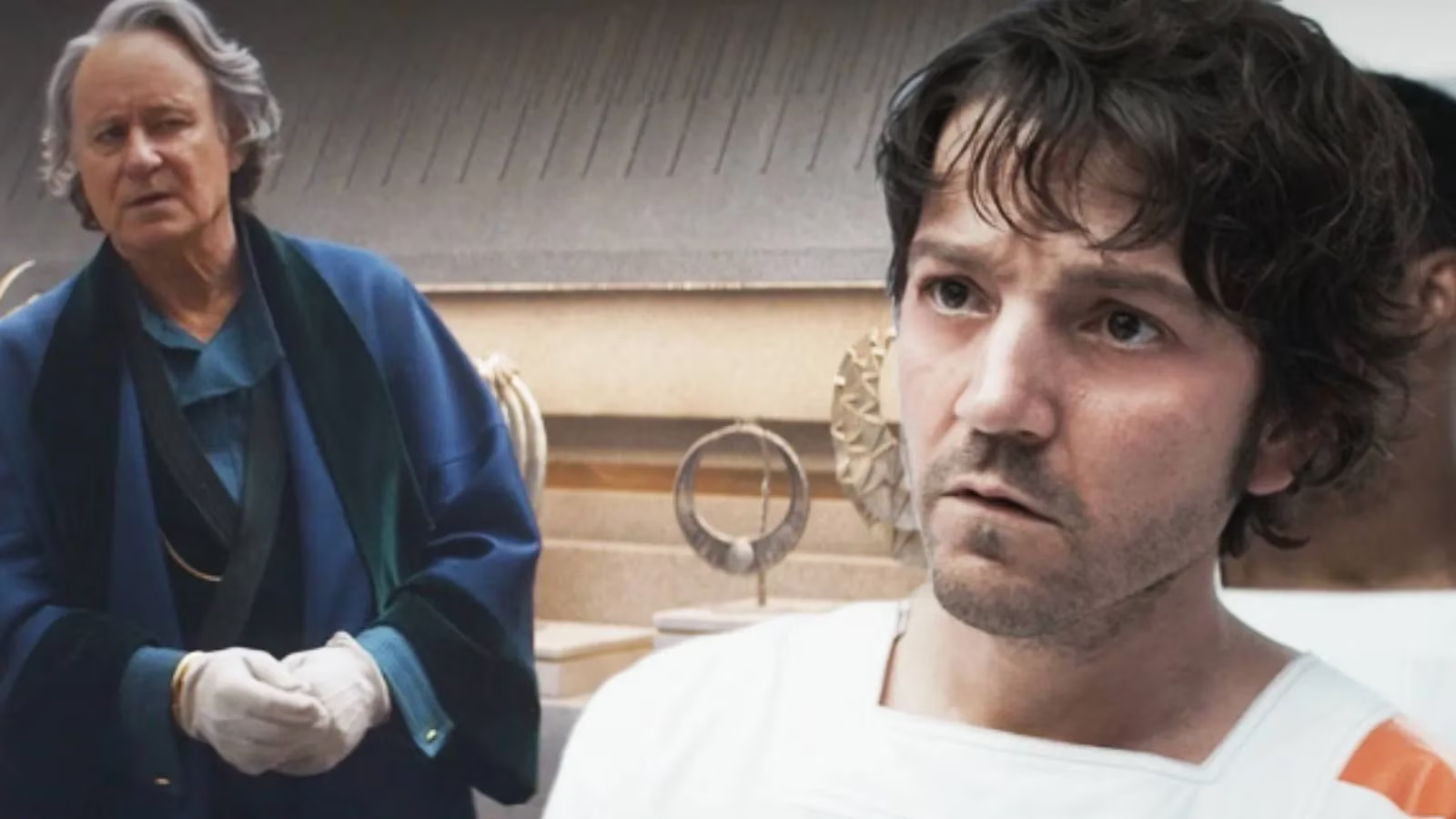
The series immediately distinguished itself by refusing to lean on the digital convenience of the Volume, the LED-wall technology that had become standard for many Star Wars productions. For Luke Hull, that decision was a direct response to the material. “We didn't want to use the volume. It doesn't suit Tony's writing,” he explained, referring to showrunner Tony Gilroy. Instead, the team relied on massive practical builds, location work, and interconnected backlot sets that gave directors genuine freedom. The town of Ferrix, for example, wasn’t a scattered collection of single-purpose stages. It was a physical, navigable streetscape where actors could walk down a main road, turn a corner, and step into a fully realized interior. This approach made the world breathe in a way that purely digital environments rarely achieve.
What makes that commitment even more remarkable is the breakneck pace at which the world came together. The production began without finished scripts — only an outline and a furious writer's room. Hull described the process as “an organic back-and-forth” where design and writing fed into each other. As sets were being conceived, script pages were still emerging, yet the collaboration felt liberating rather than chaotic. The result was a show that could “build this show from the ground up with not necessarily too many restrictions,” according to Hull. That freedom allowed for deep, thoughtful choices that would have been impossible under tighter turnaround times.
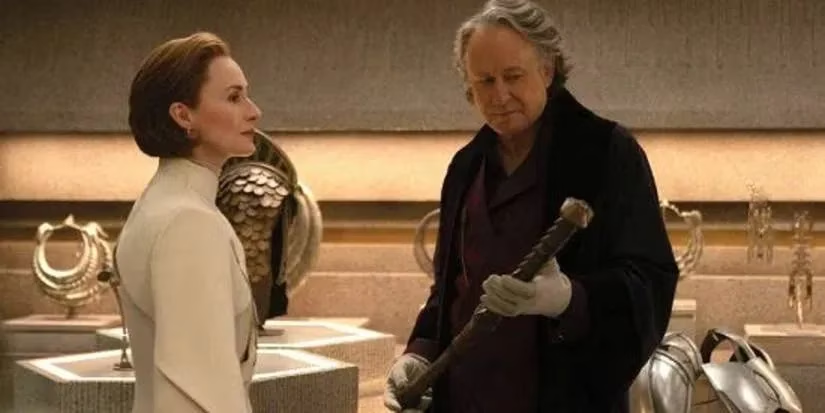
Nowhere is the depth of that design philosophy more evident than in Luthen Rael’s antiquities gallery on Coruscant. The shop is more than a set; it is a psychological portrait of a man living a double life. For Luthen, the curated collection of ancient relics serves as a front, a key into high society. But it also reflects his deepest motivation — a hatred for the Empire’s cultural homogenization. Every artifact inside the shop was chosen not as random filler or a merchandise opportunity, but as a fragment of a lost history that the Empire is actively erasing. Hull and set decorator Rebecca Alleway walked a careful line between including fan-pleasing Easter eggs and maintaining authenticity. As Hull noted, “I didn't want just trinkets in there.” The goal was to populate the space with objects that felt like they genuinely came from ancient cultures, grounding Luthen’s crusade in something tangible and mournful.
Michael Wilkinson’s costume design followed a similar philosophy, using clothing to illuminate the internal lives of characters often ignored in previous Star Wars media. Growing up with the prequels gave Wilkinson a deep appreciation for the regal silhouettes of Coruscant, but Andor demanded a different texture. Tony Gilroy insisted the story wasn’t a space opera — it was a grounded, authentic drama. For Wilkinson, that directive was a gift. He could consider a character’s motivations, how they wanted to present themselves to the world, and how colors and silhouettes could express themes rather than simply signal allegiance. Coruscant became a canvas for class and ideology, showing how senators, workers, and spies dressed not just for utility but for survival.
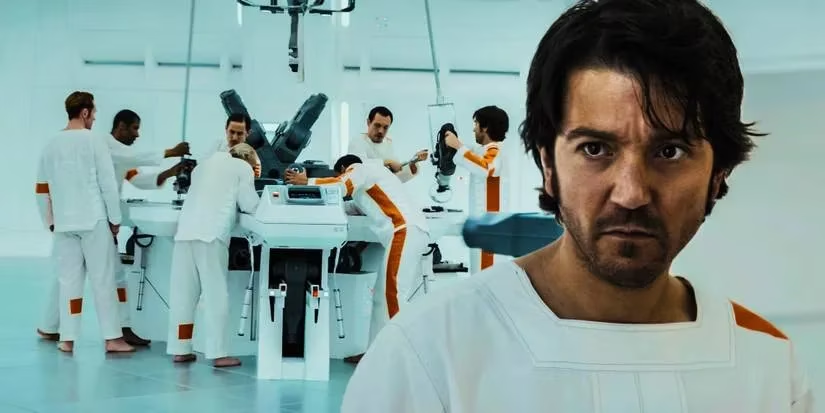
Consider the Imperial prison uniforms that dominate the arc’s final act. The stark white garments with orange flashes might at first seem like a purely practical design — guards need to spot prisoners in blindingly white spaces. But the choice carries deeper resonance, especially for fans familiar with the iconic orange-and-white Rebel flight suits. When asked if the color scheme was a deliberate inversion, Wilkinson smiled and left the door open: “feel free to read whatever else you would like into that.” The white-on-white spaces, combined with the disorienting loss of depth, turn the prison into an abstract, oppressive nightmare, while the orange marks the wearer as both object and potential rebel. It’s the kind of layered symbolism that rewards repeated viewing.
Looking back from 2026, the impact of Hull’s and Wilkinson’s work on the broader franchise is unmistakable. They proved that Star Wars could expand not through cameos or lore callbacks, but through the quiet, invisible art of worldbuilding. Their designs asked audiences to consider: whose stories haven’t been told? What does a rebellion look like from the ground up? And how can a single object — a Jedi starfighter dash ornament, a prison jumpsuit, a senator’s cloak — carry the weight of an entire galaxy’s silenced history? By trusting the intelligence of the viewer and the patience of the narrative, Andor’s creative team built something more durable than spectacle. They built a world worth fighting for.
As detailed in Polygon, strong genre storytelling often hinges on craft choices that make fictional worlds feel materially consistent, and Andor applies that same discipline to Star Wars by prioritizing practical environments, historically “worn” props, and character-driven wardrobe logic over spectacle-first iconography. Reading the series through that lens clarifies why Ferrix’s navigable streets, Luthen’s carefully curated gallery relics, and the prison’s stark, symbolic uniform palette resonate: each design decision behaves like narrative evidence, quietly reinforcing themes of class, surveillance, and cultural erasure without needing exposition.