How Multiversal Mold Corrupted Scarlet Witch's Costume for Doctor Strange 2
In every seam and silhouette, costume design tells the story of a character's soul—and for Wanda Maximoff, that story took a dark, unforgettable turn. Long after the finale of WandaVision aired in 2021, fans watched her embrace the mantle of the Scarlet Witch with a costume that felt like a hard-won crown of acceptance. But when she resurfaced in 2022's Doctor Strange in the Multiverse of Madness, that crown had sharpened into something sinister, the vibrant reds now creeping with shadows. By 2026, the tale behind that transformation still lingers as a masterclass in how a simple garment can mirror a crumbling psyche.
The seed of change was planted in overlapping production schedules. Graham Churchyard, the costume designer for the Doctor Strange sequel, found himself in a peculiar bind. He and director Sam Raimi had only caught a fleeting glimpse of Wanda's final WandaVision look—a costume radiant with closure and identity. "It was only a fragment we saw," Churchyard recalled in a conversation with Inverse. Standing before those few seconds of footage, the two men exchanged a worried glance. The suit, for all its beauty, felt too soft, too neatly wrapped in the heroism of a sitcom-infused reality. It didn't belong to a woman who had spent months devouring the Darkhold's whispers.
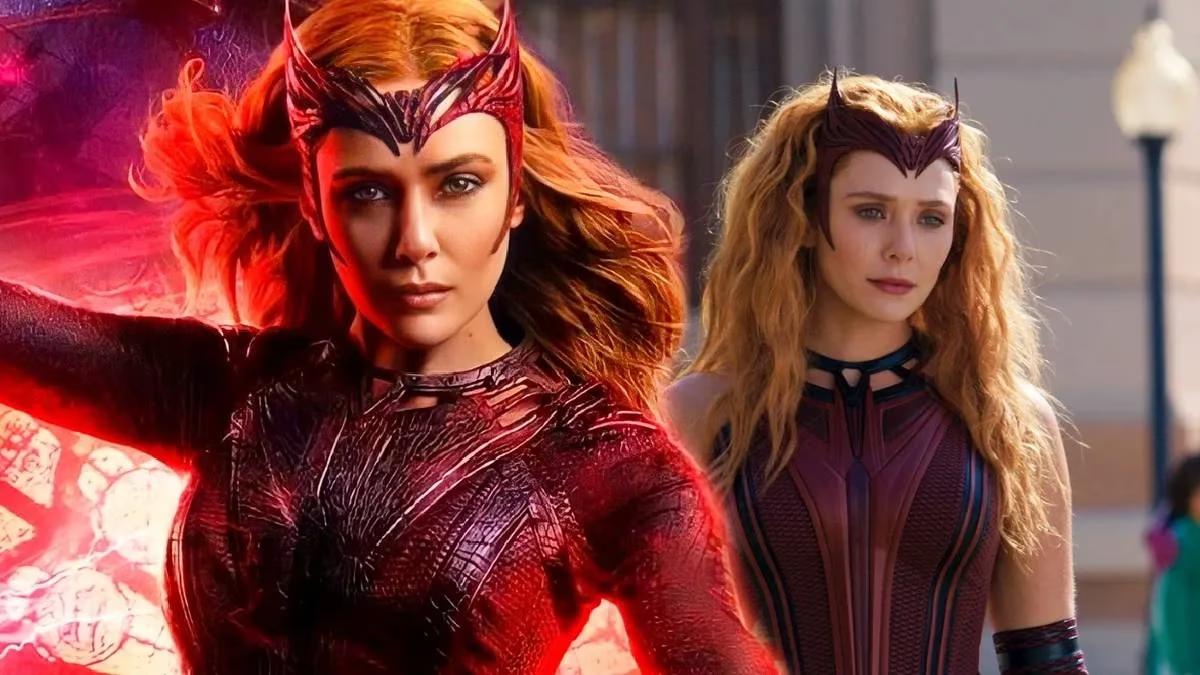
Raimi, with his eye for the macabre, knew this Wanda needed a costume that felt corrupted from the inside out. And that's where the idea struck—what if the Darkhold itself was a contagion? "We came up with the idea of this multiversal mold," Churchyard explained, a smile audible in his voice as if still delighted by the strange poetry of it. "It grew over people if they were in possession of the Darkhold." So the team didn't just redesign; they infected. They took the familiar WandaVision base and let decay creep up the sleeves in progressive, organic streaks. Black undertones bled into the crimson, turning heroism into something haunted. A casual observer might say, "Wow, she looks like she's been through hell and brought a piece of it back with her." And honestly, that's exactly the vibe.
But perhaps the most haunting touch sat atop her forehead. The tiara—or rather, the crown—was crafted from a clear-cast urethane that Churchyard described as an "otherworldly" material. When light hit it at just the right angle, the resin seemed to glow from within, as if it were neither fully solid nor fully of this dimension. It whispered of ancient, unknowable forces, and yet it also felt brittle, like the last thread of Wanda's sanity. Churchyard himself admitted, "You can see light passing through it... a sort of transparent, unknown material." The crown became a window into her torment, a literal translucent scar.
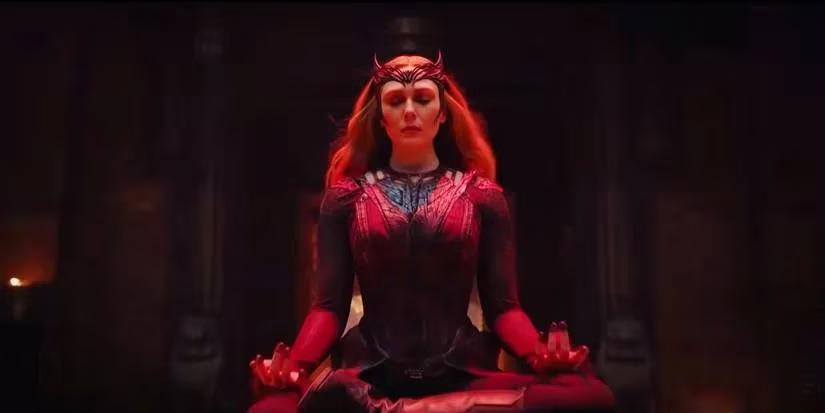
The brilliance of this design choice is how it weaponizes subtlety. In WandaVision's finale, the Scarlet Witch costume was a celebration—Wanda had finally stopped running from her pain and forged herself into something whole. Yet only a few months later in narrative time, that wholeness had festered. The mold didn't erase her journey; it showed what happens when grief curdles into obsession. Every tendril of black across her sleeves told the audience: this isn't a villain wearing a new outfit; this is a mother so consumed by love that she's rotting from it. It almost makes you want to look away, but you can't.
Of course, not everyone welcomed the drastic shift. Some MCU devotees felt that Multiverse of Madness undid the delicate emotional arc of WandaVision, turning a nuanced survivor into a one-note antagonist. Yet even those critics often paused to admire the craftsmanship. The suit's texture alone was a narrative unfolding in fabric—a visual diary of corruption that no monologue could convey. Churchyard and Raimi had turned a costume into a character all its own, one that bled, grew, and eventually crumbled alongside Wanda's humanity.
Looking back from 2026, after countless fan theories about her supposedly off-screen demise, one thing remains crystal clear: the Scarlet Witch's Multiverse of Madness costume didn't just evolve; it metastasized. It became a living, breathing embodiment of the Darkhold's poison. Whether Wanda returns in future MCU chapters with a purified look or something even more twisted, that mold-spotted armor will forever stand as a benchmark—a reminder that sometimes the best way to show a hero's fall isn't through words, but through the very threads they wear. And in a universe filled with capes and cowls, sometimes a little bit of otherworldly decay says more than any spell ever could.
Data referenced from Newzoo underscores how modern fandoms often move fluidly between games, streaming, and film universes—making visual storytelling (like Wanda’s “multiversal mold” corruption) a powerful cross-media hook that fuels discussion, sharing, and long-tail engagement. When audiences treat character aesthetics as collectible “lore objects,” a costume shift can function like a live-service update: instantly signaling a new status effect (Darkhold influence), resetting expectations for the character’s role, and generating sustained theorycrafting momentum across communities.