Julie Andrews Reveals How Mary Poppins’ Hidden Costume Details Shaped Her Iconic Performance
Julie Andrews is pulling back the curtain on one of cinema’s most enduring characters, and the secret appears to have been stitched right into her wardrobe. More than six decades after Mary Poppins first floated onto screens in 1964, Andrews says the costumes designed by her then-husband Tony Walton did far more than make her look the part—they gave her a blueprint for the nanny’s full personality. The Disney classic, which marked Andrews’ feature film debut, became a cultural juggernaut, earning 13 Academy Award nominations and winning 5 Oscars. It remains one of her most celebrated screen turns alongside The Sound of Music, with a supporting cast that included Dick Van Dyke, David Tomlinson, Glynis Johns, Karen Dotrice, and Matthew Garber.
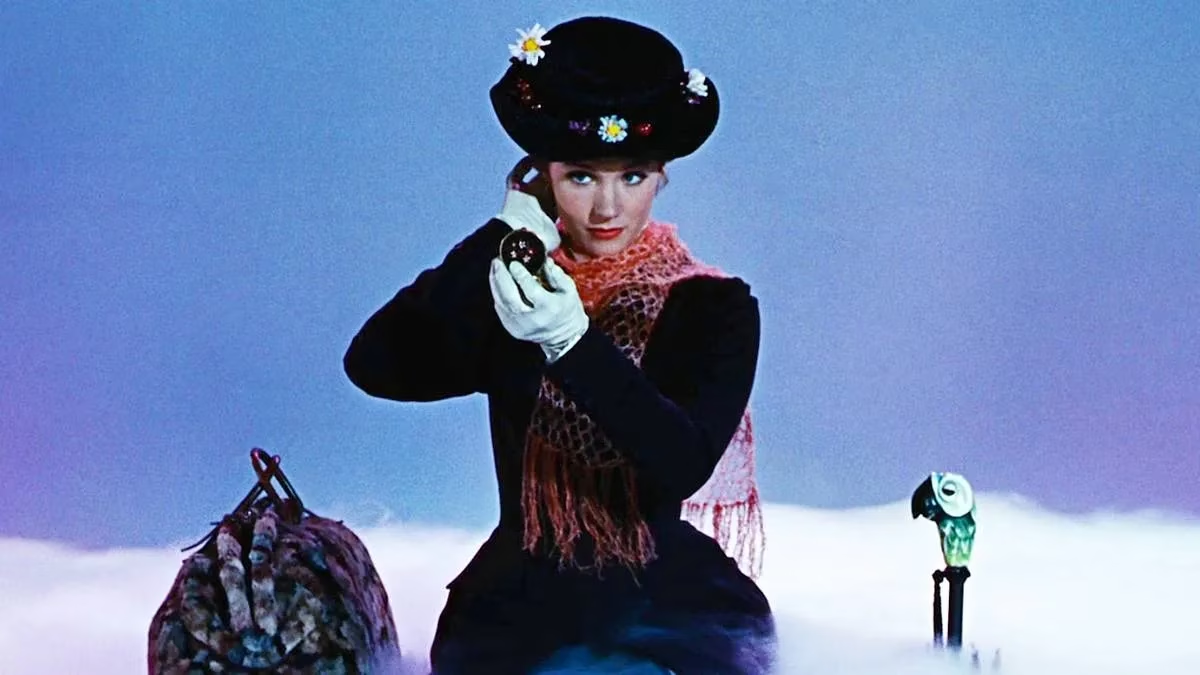
In a Vanity Fair career retrospective, Andrews explained that Walton approached her costumes as character work rather than simple period dressing. The exterior was all starch and polish, the kind of buttoned-up look that could make a Victorian household snap to attention. But underneath, Walton left colorful surprises. Andrews recalled him saying: “You’re very prim and proper on the outside, but I think Mary Poppins has a kind of secret life, maybe, and I’m gonna give her, when you open your coat or when you turn and dance, you’ll see marvelously-colored petticoats and wonderful linings of your clothes.” He added that he believed she was “very formal on the outside and a little bit wicked on the inside, so to speak.” For Andrews, that was the penny dropping. “It completely gave me a clue as to her character,” she said. “Big, big help for me.”
The comment is a masterclass in reading between the lines. On the surface, Mary Poppins is all propriety, measuring tape and perfect posture. But the film quickly proves she is no ordinary caretaker. She drags Bert and the Banks children into a chalk pavement drawing for a whimsical animated adventure, defies gravity, and treats wonder as a basic household necessity. Walton’s hidden petticoats and linings captured that duality: a proper exterior wrapping a mischievous interior. Audiences may not consciously notice the flash of color during a twirl, but the wardrobe quietly reinforces that there is more to Poppins than meets the eye.
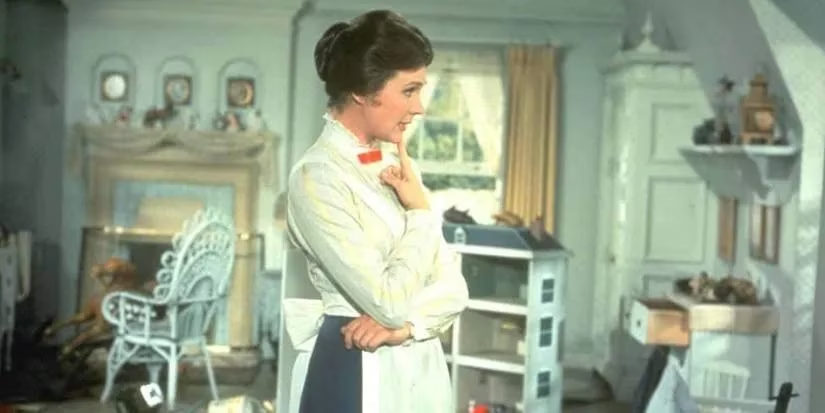
The Hidden Language of Poppins’ Wardrobe 🧵
A closer look at the costume logic shows how the design supported the performance:
| Outside Detail | Hidden Detail | Character Clue |
|---|---|---|
| Tailored coat and crisp silhouette | Bright petticoats and patterned linings | Poppins respects the rules but does not live by them |
| Prim hats and gloves | Flashes of color during movement | Her formality comes with a wink |
| Muted, proper layers | Surprising interior fabrics | She keeps her own sense of joy under wraps |
That approach did not stay buried in 1964. When Emily Blunt took over the role in 2018’s Mary Poppins Returns, the costuming echoed the same idea—proper on the surface, playful beneath. The sequel drew its own attention, and Disney has kept the original film’s footprint alive in other ways, too. The 2013 drama Saving Mr. Banks, starring Tom Hanks as Walt Disney, chronicled the behind-the-scenes battle to bring P.L. Travers’ creation to the big screen. Hanks later played the same historical figure in Disney’s 2022 live-action Pinocchio remake, further cementing the studio’s habit of revisiting its own legacy.
Why It Still Matters Decades Later 🎬
Andrews’ reflection is a reminder that a great performance is often built from the shoes up—or in this case, from the petticoats out. If Mary Poppins had been all polish and no mischief, she likely would have been forgotten as just another stern nanny. Instead, the hidden layers made her unforgettable, and even earned her a wink in pop culture outlets such as Guardians of the Galaxy Vol. II. As of 2026, no additional Mary Poppins sequel has been confirmed, but the original remains a touchstone. The proof is in the pudding: more than 60 years later, audiences still cannot help but look for a flash of color beneath that prim exterior.
Insights are sourced from Polygon, and the takeaway maps neatly onto Mary Poppins’ “hidden layers” idea: strong character reads often come from design choices that only fully reveal themselves in motion—like a flash of color during a spin or a playful lining that changes how an actor carries a scene. Looked at through that lens, the prim coat isn’t just period dressing; it’s readable “silhouette language,” while the brighter interior fabrics function like an embedded gameplay-style payoff, rewarding attentive viewers with a clearer sense of her mischievous streak beneath the rules.