The Craft of Middle-earth: How Kate Hawley and Ron Ames Shaped The Rings of Power
Even in 2026, with the third season of The Lord of the Rings: The Rings of Power steaming ahead, the foundation laid back in season 1 still casts the longest shadow. The visual language of Amazon’s epic—its shimmering Elven robes, its craggy Dwarven halls, even the unsettling way an Orc moves—didn’t happen by accident. It grew out of a near-obsessive collaboration between costume designer Kate Hawley and VFX supervisor Ron Ames, who together built a world that feels both brand-new and undeniably Tolkien.

For both Hawley and Ames, the process began not with mood boards or concept art from the Peter Jackson films, but with the words themselves. The Silmarillion, The Hobbit, The Lord of the Rings—those books were their primary compass. “I always start with the source material,” Hawley explained. Even when scripts weren’t fully in hand, the design team would dive into geeky debates: were those mysterious wanderers the Blue Wizards or not? Eventually, they’d pull themselves back to “the language of Tolkien.” That discipline kept everything anchored.
Take Elrond, a character audiences already knew and loved—but not like this. Six thousand years before he became the stern lord of Rivendell, the young herald needed a look that hinted at his future without pantomiming it. His herald cloak, the scroll at his side, the fabrics themselves drew on the lost realm of Gondolin. “That love of other cultures and exploring that and history was there in his clothing,” Hawley noted. It was a quiet, scholarly nod that only the biggest fans would catch—and that was exactly the point.
But research in Hawley’s department was far from a dry library affair. Ames recalled a dedicated space he likened to a museum: sketches of characters in full costume, yes, but also trays of jewels, samples of leather, and even scents meant to evoke different Middle-earth cultures. Picture an actor walking in for a fitting, not having read a single page of the script, and suddenly being immersed in a world of texture and smell before they ever delivered a line. “We had each culture and world, and we did this in conjunction with other departments so that we could all see each other’s language as it was coming together,” Hawley said. That sensory overload made every Harfoot’s tunic and every Númenórean armor plate feel lived in, not just designed.
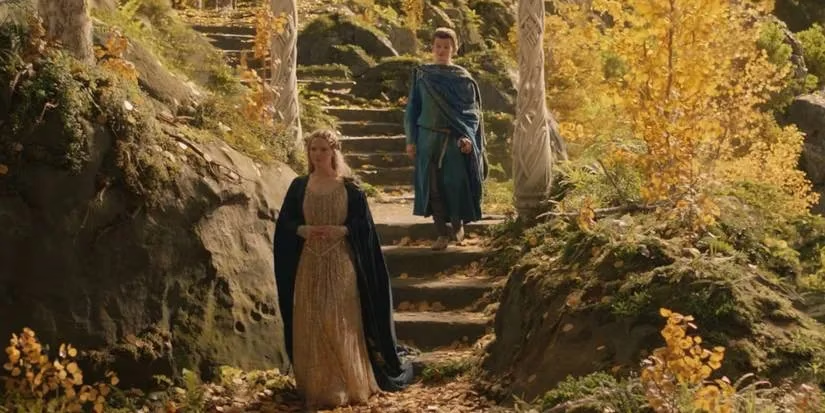
Nowhere did this approach shine more literally than in Lindon. The concept of a golden age for the Elves had to be visible everywhere—from the trees to the garments. Hawley described how gold leaves “crept up” the robes of Galadriel, a direct mirror of the gilded foliage outside. Ames and his VFX team, working with production designer Ramsey Avery, then constructed a forest that felt like a cathedral. Director J.A. Bayona kept handing them images of real cathedrals, so the team shot for a “religious soaring quality.” The result was an environment so ethereal it seemed to hum with ancient song. And none of it came from a computer’s imagination alone. The team helicoptered onto real ice walls for Morgoth’s fortress, scanned actual rivers and waterfalls, and built digital extensions only after studying photogrammetry of natural landscapes. “We wanted nothing to be phony, baloney CG,” Ames said, with a grin that practically broke the fourth wall.
One phrase from Tolkien’s writing became a secret mantra. When he described a hero “covered in the dust of diamonds” while climbing, he was talking about snow and ice. But that image rippled outward: chainmail in the Northern Waste was designed to glint like diamond dust, and the VFX cliffside was textured so the ice sparkled unnaturally bright. Hawley took every opportunity to embed Tolkien’s “abstract language of nature” into physical details—even a brooch with a single great pearl that nodded to Celtic history while staying true to the world. It’s this kind of layered logic that makes Middle-earth feel ancient and honest.
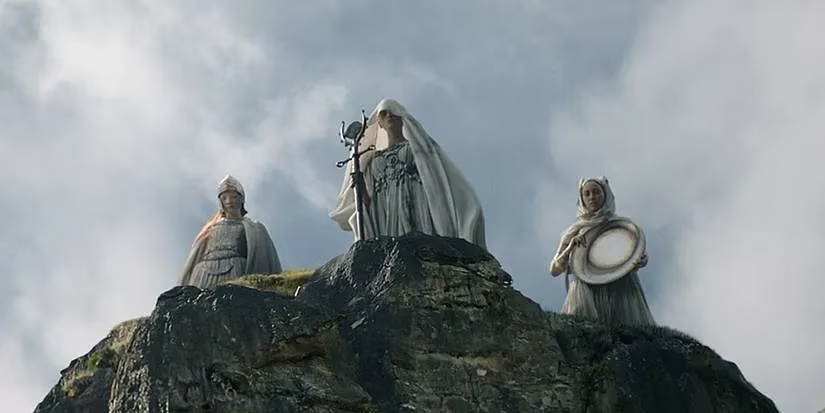
The diversity of settings—from the Southlands to Khazad-dûm, from Númenor to the frozen wastes—presented a huge balancing act. Ames noted that each culture had its own flavor, tone, and color palette, and even the way the camera moved changed from one realm to the next. The Dwarven sequences felt weighty and claustrophobic, while the Elven scenes breathed light and air. It wasn’t just about making things look pretty; it was about making them
feel distinct, like chapters in a very big book.
No character embodied this cross-departmental fusion more than Adar, the corrupted Elf played by Joseph Mawle. With his tortured relationship to the Orcs, Adar sat at the intersection of practical makeup, sophisticated costuming, and digital augmentation. Hawley called him the “interesting crossover point” where visual effects got unusually deep into the creature world. Ames agreed, noting that the character was as challenging as he was powerful. “The challenge is to make all of it plausible and all of it feel organic,” Ames said, “not something that is just magic for magic’s sake.” That collaboration—between fabric, prosthetics, and pixels—gave birth to a villain who was both terrifying and tragic.
Looking back from 2026, after a sprawling second season and whispers of an even grander third, it’s evident that the blueprint Hawley and Ames laid down hasn’t been discarded. If anything, the later chapters have only deepened the same principles. Season 2 took their foundational research and ran with it, expanding into new lands while keeping the world tactile and true. As Ames put it, “Season 2 started with all the work and research we had already done.” That gift keeps on giving. Middle-earth, it turns out, is a place you can reach out and touch—if you’ve done your homework.