The Terrifying Possibility: Green Goblin's Black Suit Legacy and Marvel's 40th Anniversary Tribute
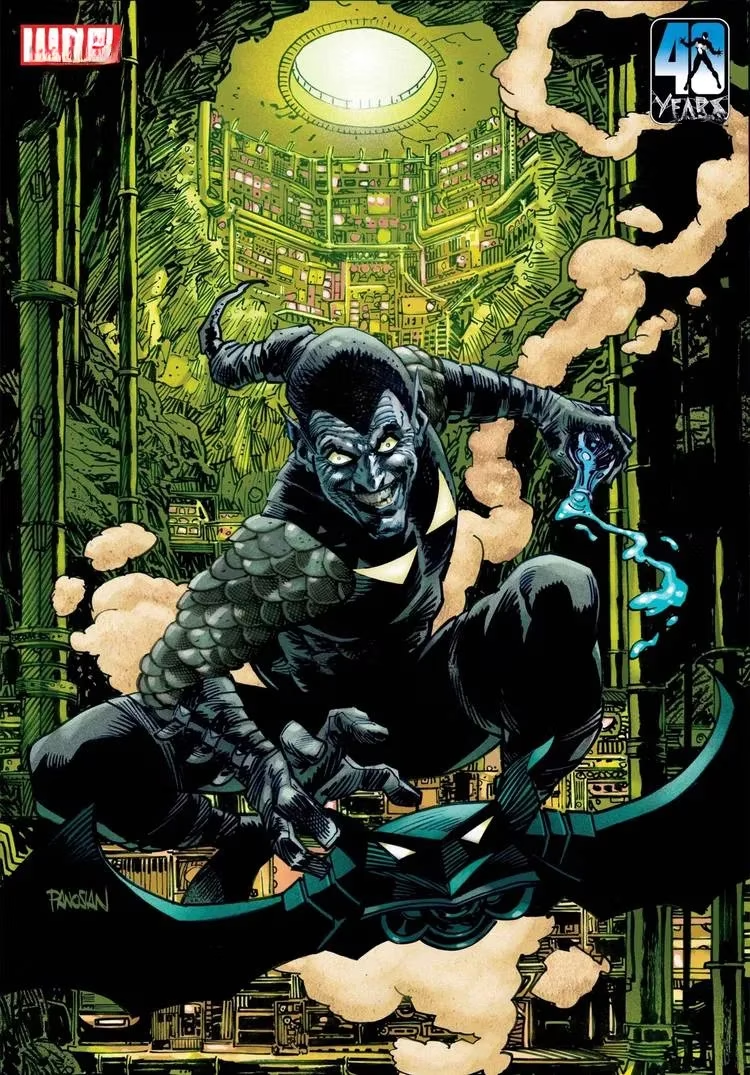
As a lifelong gamer and comic enthusiast, the year 2026 marks a particularly chilling milestone in Marvel history—the 40th anniversary of Spider-Man's Black Suit era. Marvel's celebration has taken an unexpectedly dark turn with variant covers imagining what might have happened if other characters had bonded with the symbiote instead of Peter Parker. Among these speculative designs, one stands out like a shadow cast by a malevolent moon: the Green Goblin clad in the iconic black suit. This artistic exploration isn't just cosmetic fan service; it's a window into a terrifying alternate reality where Norman Osborn's madness merged with alien power. The very concept sends shivers down my spine, like imagining a master sculptor given nuclear materials instead of clay—the potential for destruction becomes exponentially more refined and catastrophic.
The most compelling of these variant covers comes from artist Dan Panosian for Spider-Man: Shadow of the Green Goblin #2. While other characters like Spider-Woman or Iron Man getting the symbiote might present interesting scenarios, Norman Osborn's transformation represents something fundamentally different. He's already one of Spider-Man's most dangerous foes—a brilliant but unhinged industrialist with enhanced strength, advanced weaponry, and a complete disregard for human life. Adding the Venom symbiote to that equation would be like giving a master arsonist control over wildfire itself; the destruction wouldn't just increase—it would become sentient, adaptive, and infinitely more terrifying.
What makes this concept so fascinating is how it recontextualizes Marvel history. The original Black Suit era fundamentally altered Spider-Man's story and spawned numerous legacy characters:
The Symbiote Legacy Tree:
-
1984: Spider-Man acquires black suit (alien symbiote)
-
1988: Eddie Brock becomes Venom
-
1992: Cletus Kasady becomes Carnage
-
2018: Norman Osborn becomes Red Goblin (Carnage symbiote)
-
2020: Knull, the King in Black, emerges
-
2026: 40th anniversary variant covers explore alternate symbiote hosts
This timeline shows how one costume change created ripples throughout the Marvel Universe. Without Spider-Man's black suit era, characters like Venom, Carnage, and even the cosmic horror of Knull might never have existed. But the variant covers ask: what if the symbiote had chosen differently from the start?
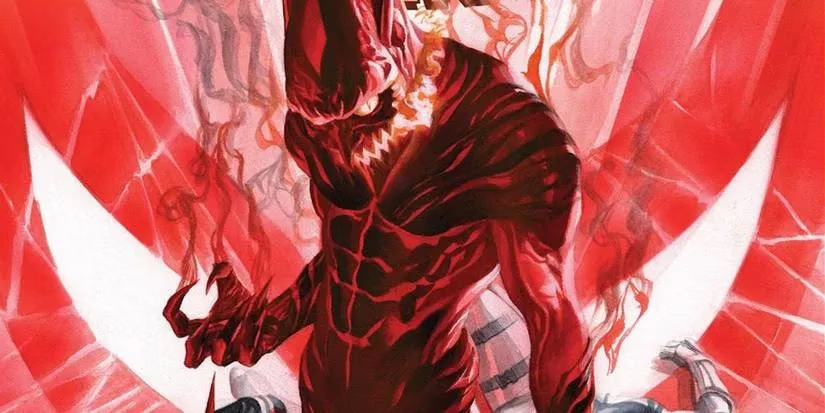
Norman Osborn with the Venom symbiote presents a particularly disturbing scenario because we've already seen a version of this in the 2018 Amazing Spider-Man storyline where he bonded with the Carnage symbiote to become the Red Goblin. That transformation turned him into a complete maniac who briefly believed himself to be Cletus Kasady. However, the Venom symbiote would likely create a different dynamic—more controlled, more strategic, and therefore potentially more dangerous. Where Carnage represents chaotic, impulse-driven violence, Venom offers predatory intelligence. Norman with Venom wouldn't be a slave to impulses; he'd be a conductor orchestrating a symphony of destruction, each movement calculated to maximize suffering and chaos.
The psychological implications are what truly haunt me as a fan. Norman's existing madness—oscillating between cold corporate calculation and Goblin-induced mania—would merge with the symbiote's alien consciousness. This wouldn't be a simple power upgrade; it would be an evolutionary leap in villainy. Imagine a brilliant tactician whose strategic mind has been sharpened to a razor's edge, now amplified by an alien entity that can shapeshift, regenerate, and adapt to any threat. It's like watching a master chess player suddenly gain the ability to change the board's physics mid-game—the fundamental rules of engagement would no longer apply.
Marvel's variant covers serve as more than just collectible artwork; they're narrative thought experiments that explore character essence through visual hypotheticals. The Green Goblin's black suit variant works so well because it taps into the core of what makes Norman Osborn frightening: his human intelligence coupled with superhuman resources and complete moral bankruptcy. The symbiote wouldn't just make him stronger or more durable—it would amplify his existing traits to nightmarish proportions.
Consider the practical implications if this had happened in mainstream continuity:
Potential Consequences of Goblin-Venom:
| Aspect | Green Goblin | Goblin-Venom Hybrid |
|---|---|---|
| Strength | Enhanced human (≈10 tons) | Symbiote-enhanced (≈70+ tons) |
| Durability | Armored costume | Rapid healing, shapeshifting armor |
| Weapons | Pumpkin bombs, glider | Living weapons, tendrils, organic webbing |
| Psychology | Unstable genius | Genius amplified by alien consciousness |
| Stealth | Limited | Near-perfect camouflage, spider-sense avoidance |
This table illustrates why the concept is so terrifying. Norman already represents the danger of human evil amplified by technology and resources. Adding the symbiote transforms him from a formidable opponent into an existential threat—a villain who could potentially outthink and outmaneuver heroes on multiple fronts simultaneously.
As I reflect on this 40th anniversary celebration in 2026, what strikes me most is how these variant covers honor the legacy of the Black Suit era by exploring its road-not-taken possibilities. The artwork serves as a reminder that some of the most interesting stories in comics come from asking "what if?" questions that challenge established continuity. The Green Goblin variant specifically works because it feels both shocking and inevitable—like discovering a hidden door in a familiar room that leads somewhere profoundly dark.
Ultimately, these covers celebrate Spider-Man's history by showing us how easily it could have been different. While characters like Iron Man or Daredevil might have remained heroes with the symbiote (though likely darker versions of themselves), Norman Osborn represents the perfect storm of personality traits that would make him an ideal—and horrific—host. The world has seen what he can do as Green Goblin and Red Goblin; a Goblin-Venom hybrid would be like watching a master painter given only blood and shadow as mediums—the resulting artwork would be beautiful in its technical execution but horrifying in its subject matter and implications.
In the end, I'm grateful this remains a "what if" scenario rather than mainstream canon. Some doors are better left unopened, some shadows better left unexplored. But as a thought experiment and artistic celebration, the Green Goblin's black suit variant stands as one of the most compelling pieces of Spider-Man anniversary artwork I've seen—a dark reflection of what might have been, and a reminder of why Peter Parker's willpower in rejecting the symbiote remains one of his greatest heroic moments.