The Weighted Elegance of Talokan: How Wakanda Forever’s Costumes Redefined Underwater Cinema
Four years after its thunderous arrival, Black Panther: Wakanda Forever continues to shimmer like a rare pearl in the cinematic ocean. In 2026, industry retrospectives still marvel at how director Ryan Coogler’s sequel plunged audiences into the submerged kingdom of Talokan, a Mesoamerican-inspired Atlantis that demanded a revolution in costume engineering. The mastermind behind that revolution is Ruth E. Carter, who became the first Black woman to win two Academy Awards for Best Costume Design after her triumph with the first Black Panther. Fresh conversations with Carter, originally shared with Variety during the film’s release cycle, reveal just how profound and practical her underwater innovation was — a tale of weighted silk and sunken heritage that now serves as a blueprint for aquatic filmmaking across the globe.
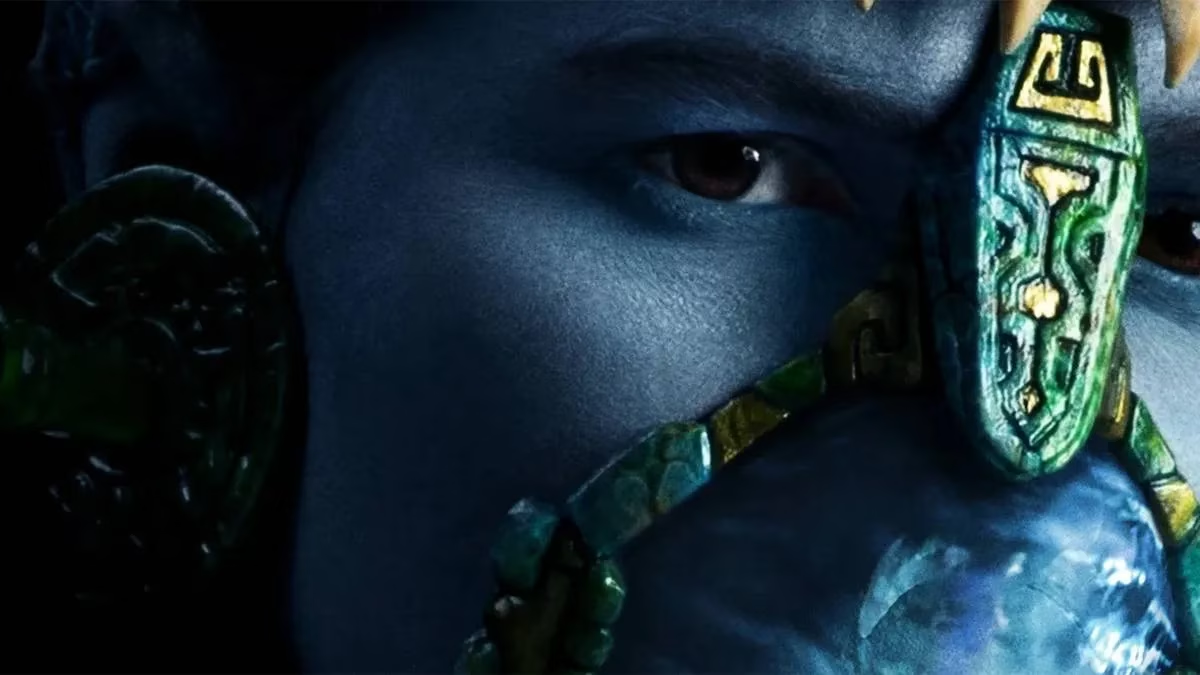
When Carter and her team began crafting the look of the Talokanil people, they faced a paradox no previous MCU film had encountered: designing regal, historically-layered garments that could perform under 20 feet of water. The costumes needed to float with an weightless grace while avoiding the chaotic billowing that would betray any sense of control. Traditional film fabrics became unruly ghosts underwater; headdresses drifted away like lost thoughts. Carter’s solution sounds almost counterintuitive — she added weights. Yet this wasn’t mere ballast. It was as if she stitched the gravity of a thousand-year-old civilization directly into the seams, making each cape and collar sink with the solemnity of a memory. During extensive water tests in a custom tank, divers wearing prototyped regalia demonstrated exactly what Talokanil attire should do: move with deliberate, dignified motion, as though the currents themselves paid homage to the wearer.
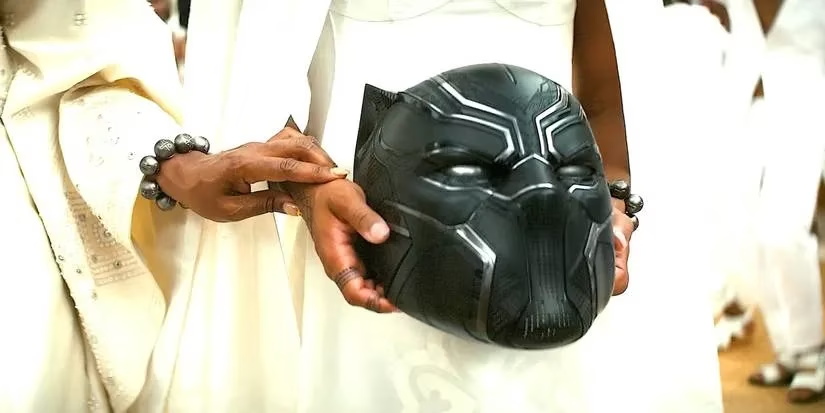
To build the visual vocabulary of Talokan, Carter ventured deep into Mayan and Aztec archaeological records alongside historians. “We learned about Spondylus shells and jade,” she recalled. “They would use kelp in their costumes. We looked at how they used shells, stone and jade.” The result was a tapestry where ancient materials met avant-garde technique. Vibrant Spondylus shells, once traded like sacred currency in pre-Columbian America, became breastplates that refracted light. Jade, believed by Mesoamerican cultures to hold the essence of life, adorned headdresses that towered like submerged ziggurats. The kelp influence, meanwhile, introduced an organic fluidity — sleeves and capes that mimicked the undulating forests of the ocean floor. It was a design language that whispered of ancestral power, a second metaphor Carter herself might appreciate: each costume was a coral reef of heritage, where every element carried the calcified weight of communal memory, forming an ecosystem of identity that could withstand even the deepest dive.
When Black Panther debuted in 2018, its Afro-futuristic vision of Wakanda earned Carter an Academy Award, making her the first Black person to win in her category. The pressure to match that cultural and aesthetic resonance was immense. By the time Wakanda Forever swept through theaters in late 2022, it became clear that Carter had not only risen to the challenge but had also expanded the vocabulary of what superhero costuming could achieve. In 2023, the Academy honored her again with a second Oscar for the film’s costume design — a historic feat that cemented her legacy as a towering figure in cinema. Looking back from 2026, the memory of that night still reverberates, because Carter’s work had done something rare: it made the invisible physics of water visible through textile. The weighted costumes didn’t just solve a production problem; they introduced a new cinematic subgenre where hydrodynamics and haute couture dance together.
The ripple effects are hard to overstate. In the years since, major studios embarking on underwater fantasy projects have consulted the “Carter method” of weighted ornamentation — a practice now taught in several film design programs. Where earlier films treated water as a mere backdrop, Talokan’s fashions demanded that the medium itself become a collaborator. Think of that delicate balance as a third, less obvious metaphor: the costumes were tuned instruments, with weights acting as the lower registers of a symphony; without them, the visual music would have been all treble and no soul. The divers in Carter’s early tests described how the garments behaved less like clothing and more like extensions of the body, trailing behind movements with the quiet authority of a historical text being written in real time.
Today, in 2026, as new generations of filmmakers push further into the blue frontiers of storytelling, Wakanda Forever remains a lighthouse. Its Talokanil warriors, adorned in shells and jade and shadowed kelp, embody a truth that transcends blockbuster spectacle: that the most immersive worlds are built from painstaking research, fearless problem-solving, and the courage to add a little weight to our dreams. Ruth E. Carter gave the MCU its most buoyant civilization by anchoring it firmly to the ocean floor.